BPC-157 vs TB-500 is one of the most common comparisons in regenerative peptide research. Both compounds appear throughout preclinical literature on tendon, muscle, gut and wound repair, and they are often studied together. Yet they differ in origin, size, structure and proposed mechanism. This article compares the two side by side to help laboratories design better experiments. All products discussed are available from Peptide Sciences for research use only.
BPC-157 vs TB-500 at a Glance
| Property | BPC-157 | TB-500 (Thymosin Beta-4) |
|---|---|---|
| Origin | Fragment of a gastric juice protein | Naturally occurring in almost all cells |
| Length | 15 amino acids | 43 amino acids |
| Molecular weight | ~1,419 Da | ~4,963 Da |
| Key feature | Stable in gastric acid | Major G-actin–sequestering peptide |
| Main pathways studied | VEGFR2, nitric oxide, FAK-paxillin | Actin dynamics, cell migration, angiogenesis |
| Common research models | Tendon, ligament, GI tract, vascular | Wound, corneal, cardiac, muscle |
What Is BPC-157?
BPC-157 (Body Protection Compound-157) is a synthetic pentadecapeptide with the sequence GEPPPGKPADDAGLV. It is derived from a larger protein found in gastric juice and is unusual among short peptides for remaining stable in acidic conditions. Since the 1990s, it has been described in hundreds of rodent studies examining tendon-to-bone healing, muscle injury, intestinal anastomosis and protection against NSAID-induced gut damage.
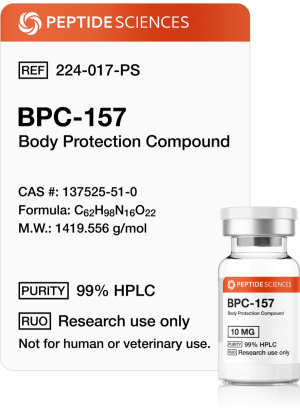
Mechanistic research links BPC-157 to up-regulation of VEGFR2 signalling, modulation of the nitric-oxide system and activation of the FAK-paxillin pathway, which drives fibroblast migration. Some studies also report increased growth-hormone receptor expression in tendon fibroblasts. Researchers can choose from BPC-157 5mg, BPC-157 10mg and BPC-157 15mg vials, or BPC-157 capsules for oral-delivery models.
What Is TB-500?
TB-500 is the research name commonly used for synthetic thymosin beta-4 (Tβ4), a 43-amino-acid peptide that is one of the most abundant intracellular peptides in mammals. Its primary known function is binding and sequestering G-actin, which regulates the cytoskeleton and controls how cells move and change shape.
In preclinical work, thymosin beta-4 has been studied for endothelial cell migration, new blood-vessel formation, reduced inflammatory signalling, corneal repair and cardiac tissue protection after injury. The central actin-binding motif LKKTETQ (residues 17-23) is thought to drive much of this activity, which is why the TB-500 Fragment 17-23 is used in structure-function studies. Full-length material is available as TB-500 2mg, 5mg and 10mg.
Key Differences in Mechanism
Vascular Signalling vs Cytoskeletal Regulation
BPC-157 research focuses largely on vascular and cytoprotective signalling: blood-vessel growth, endothelial protection and nitric-oxide balance. TB-500 research centres on the cytoskeleton: by controlling actin polymerisation, thymosin beta-4 influences how quickly cells can migrate into an injured area.
Local Stability vs Systemic Distribution
BPC-157’s stability in acidic environments has made it a frequent subject of oral and gastrointestinal studies. Thymosin beta-4 is highly water-soluble and naturally present in platelets and wound fluid, so research often examines its distribution and activity across tissues.
Size and Synthesis
At 15 residues, BPC-157 is quicker and less costly to synthesise than the 43-residue thymosin beta-4. Longer sequences require more coupling cycles, so verifying purity and identity by HPLC and mass spectrometry is especially important for TB-500.
Why Researchers Study BPC-157 and TB-500 Together
Because the two peptides appear to act on different stages of repair, angiogenic signalling for BPC-157 and cell migration for thymosin beta-4, many investigators study them in combination to look for complementary effects. A well-designed combination study usually includes:
- A vehicle control group.
- A BPC-157-only arm and a TB-500-only arm.
- A combination arm using the same amounts as the single-peptide arms.
- Identical lots across all arms, documented by COA.
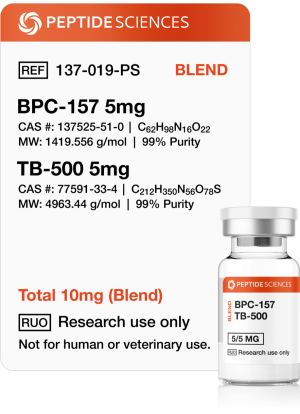
For convenience, Peptide Sciences offers pre-mixed vials: the BPC-157 + TB-500 10mg Blend and 20mg Blend. For skin-focused research, the GLOW Blend adds GHK-Cu, and the KLOW Blend also includes KPV.
Which Should a Lab Choose?
- Choose BPC-157 for gastrointestinal models, vascular and nitric-oxide studies, or oral-delivery research.
- Choose TB-500 for cell-migration, actin and wound-closure assays, or cardiac and corneal models.
- Choose both (or a blend) when the research question is about complementary repair pathways.
Limitations of the Current Evidence
Most published data on both peptides come from cell culture and animal models, and some findings come from a limited number of research groups. Neither compound is an approved drug, and both are sold only for laboratory research. Researchers should review the primary literature, for example BPC-157 studies on PubMed, and design studies with proper controls.
Summary
In the BPC-157 vs TB-500 comparison, BPC-157 is a small, acid-stable peptide studied mainly for vascular and cytoprotective signalling, while TB-500 is a larger, naturally abundant actin-regulating peptide studied for cell migration and tissue remodelling. Explore both in our healing peptides collection, and see our complete guide to research peptides for more background.