The SS-31 peptide, also known as elamipretide, is one of the most widely studied mitochondria-targeting peptides in the research literature. Researchers searching for SS-31 usually want to know three things: what the molecule is, how it interacts with the inner mitochondrial membrane, and what published studies have actually examined. This guide answers each of those questions in plain, laboratory-focused language, then covers handling, purity and how SS-31 compares with other mitochondrial research compounds.
What Is the SS-31 Peptide?
SS-31 belongs to a family of small synthetic compounds called Szeto-Schiller peptides, named after researchers Hazel Szeto and Peter Schiller, who described them while working on opioid peptide analogues. Unlike most peptides, which struggle to cross cell membranes, the SS series was found to be cell-permeable and to concentrate in mitochondria. In the literature SS-31 also appears under the development names elamipretide, MTP-131 and Bendavia, so it is worth searching all four names when reviewing published work.
Structure and Chemical Profile of Elamipretide
SS-31 is a tetrapeptide with an alternating aromatic–cationic design. Key characteristics reported in the literature include:
- Sequence: D-Arg–2′,6′-dimethyl-Tyr–Lys–Phe–NH2
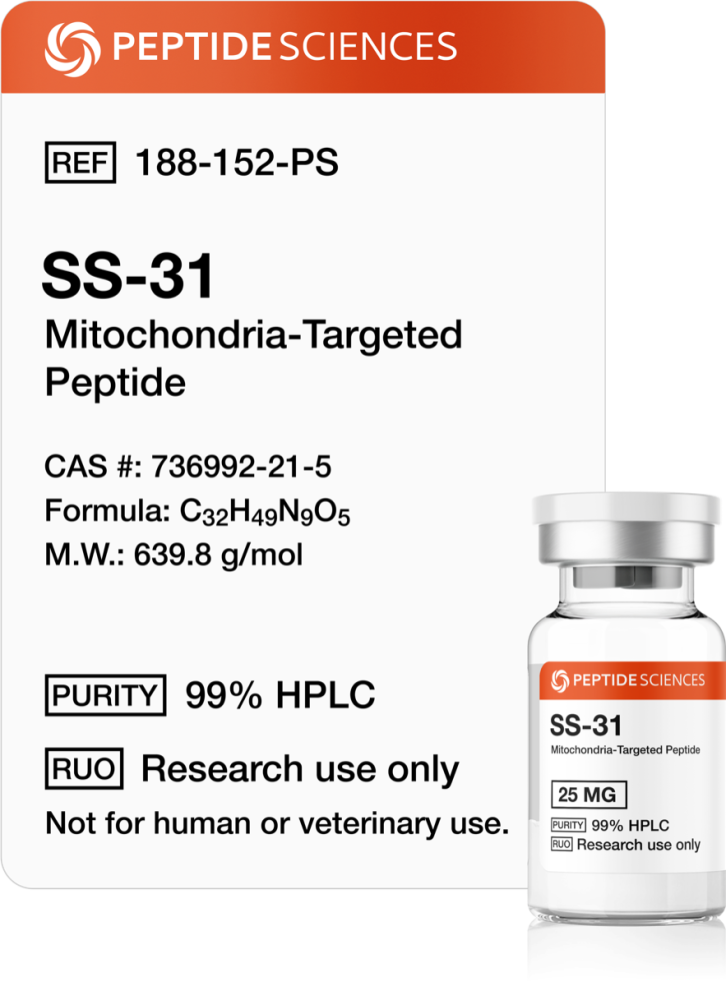
- Molecular formula: C32H49N9O5 (molecular weight approximately 640 g/mol)
- Net charge: +3 at physiological pH, which is thought to drive its attraction to negatively charged mitochondrial lipids
- D-amino acid at position 1: improves resistance to enzymatic degradation compared with all-L sequences
- Dimethyltyrosine (Dmt): an aromatic residue associated with the peptide's antioxidant-related properties in early studies
How SS-31 Interacts With Mitochondria: The Cardiolipin Mechanism
The central mechanism proposed for the SS-31 peptide involves cardiolipin, a phospholipid found almost exclusively in the inner mitochondrial membrane. Cardiolipin helps shape the folded cristae and anchors the protein complexes of the electron transport chain. Research suggests that SS-31 selectively binds cardiolipin, and studies have proposed several downstream effects:
- Stabilising cristae architecture and the organisation of respiratory supercomplexes
- Supporting more efficient electron transfer, including interactions involving cytochrome c
- Reducing the generation of reactive oxygen species (ROS) in stressed cell and animal models
- Limiting cardiolipin peroxidation, which is associated with mitochondrial dysfunction
What Preclinical and Clinical Research Has Examined
SS-31 has been studied across a broad range of experimental settings. In animal models, it has been investigated in ischaemia–reperfusion injury of the heart and kidney, models of heart failure, age-related decline in skeletal muscle mitochondrial function in mice, and models of neurodegeneration and retinal stress. Elamipretide has also progressed into human clinical trials, including studies in Barth syndrome (a rare cardiolipin disorder), primary mitochondrial myopathy, heart failure and age-related macular degeneration. Results have been mixed: some trials reported signals on secondary measures while others did not meet their primary endpoints. For researchers, the takeaway is that SS-31 is a well-characterised tool compound with a large body of mechanistic literature, not a settled answer to any clinical question. Always review the original papers and trial registries rather than secondary summaries.

SS-31 vs Other Mitochondrial Research Compounds
Laboratories studying mitochondrial function often compare SS-31 with compounds that act through entirely different pathways. Understanding those differences helps when designing comparative experiments:
- SS-31: a cardiolipin-binding peptide that acts on inner membrane structure and electron transport efficiency.
- Methylene Blue research compound: a redox-active small molecule studied as an alternative electron carrier that can shuttle electrons within the respiratory chain.
- SLU-PP-332 (ERR agonist): a synthetic estrogen-related receptor agonist investigated in mouse studies for effects on oxidative metabolism gene programmes and mitochondrial biogenesis.
- 5-Amino-1MQ (NNMT inhibitor): a small molecule studied in preclinical models for its inhibition of nicotinamide N-methyltransferase and its relationship to NAD+ metabolism.
Handling, Storage and Purity of SS-31 Peptide
SS-31 is supplied as a lyophilised powder. Like most research peptides, it is best kept sealed, dry, protected from light and refrigerated or frozen until use, with repeated freeze–thaw cycles avoided once a solution has been prepared for laboratory work. Our guide to storing lyophilised and reconstituted research peptides covers temperature ranges and aliquoting in detail. Before running experiments, confirm that each lot comes with a certificate of analysis showing HPLC purity and a mass spectrometry result that matches the expected molecular weight of roughly 640 Da. If you are unsure how to interpret those documents, see how to read a peptide certificate of analysis.
SS-31 Peptide FAQ
Is SS-31 the same as elamipretide?
Yes. SS-31 is the original research code name; elamipretide is the nonproprietary name used in clinical development. MTP-131 and Bendavia are earlier development names for the same tetrapeptide.
Why does SS-31 accumulate in mitochondria?
Research suggests its alternating aromatic and positively charged residues allow it to cross cell membranes and concentrate at the inner mitochondrial membrane, where it associates with negatively charged cardiolipin.
Is SS-31 an antioxidant?
It has been described as reducing ROS production in experimental models, but most current literature frames it as a membrane-stabilising, cardiolipin-targeting peptide rather than a direct antioxidant scavenger.
How should SS-31 be stored in the lab?
Keep the lyophilised vial sealed, cold and dry. Once reconstituted for laboratory use, store aliquots refrigerated or frozen and minimise freeze–thaw cycles.
Sourcing SS-31 Peptide for Your Laboratory
If your research involves mitochondrial bioenergetics, oxidative stress models or cardiolipin biology, the SS-31 peptide is a well-documented reference compound to include. Peptide Sciences supplies SS-31 25mg lyophilised research peptide for laboratory use, alongside related mitochondrial research compounds. Review the product page for specifications, then explore the full catalogue to build out your study.
View SS-31 25mgAll products are sold strictly for laboratory research use only. They are not intended for human or animal consumption, or for diagnostic or therapeutic use. Nothing in this article is medical advice.