

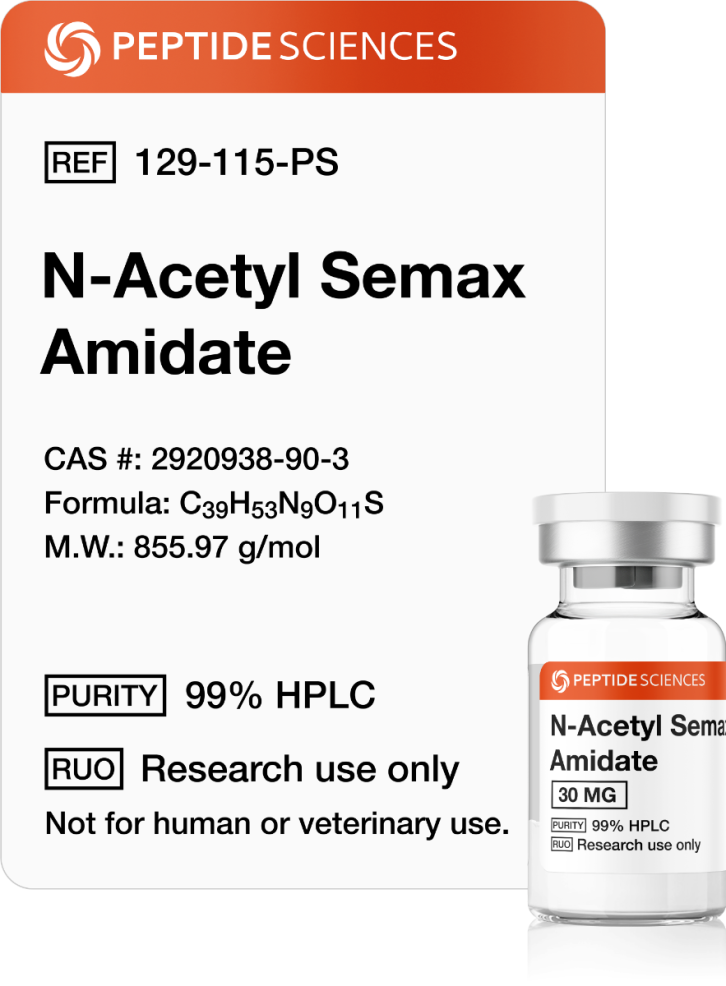
Semax and Selank are two of the most often searched nootropic research peptides, and both come in two forms: the original heptapeptide and an N-acetyl amidate version. This spotlight explains what each peptide is, what preclinical research has looked at, how the standard and modified forms differ, and which product fits which kind of lab study.

What Are Semax and Selank?
Both peptides came out of research at the Institute of Molecular Genetics of the Russian Academy of Sciences. Each is a short synthetic peptide built by adding a Pro-Gly-Pro tail to a naturally occurring sequence. That tripeptide extension was chosen because it has been studied for slowing enzymatic breakdown of the parent fragment.
- Semax: Met-Glu-His-Phe-Pro-Gly-Pro, an analogue of the ACTH(4–10) fragment of adrenocorticotropic hormone, without ACTH's hormonal (steroidogenic) activity.
- Selank: Thr-Lys-Pro-Arg-Pro-Gly-Pro, an analogue of tuftsin, a tetrapeptide fragment of immunoglobulin G.
Semax Research: Mechanisms Studied
Most published Semax work is in cell culture and rodent models, much of it in Russian-language journals. Areas researchers have looked at include:
- Neurotrophic signalling: rodent studies have reported changes in brain-derived neurotrophic factor (BDNF) and its receptor TrkB in the hippocampus and frontal cortex.
- Ischemia models: Semax has been studied in experimental models of cerebral ischemia, where gene expression profiling looked at inflammatory and vascular pathways.
- Monoamine systems: some animal research suggests Semax affects dopaminergic and serotonergic activity in the brain.

Selank Research: Mechanisms Studied
Selank research has focused on behaviour and on interactions with the immune system, which fits its tuftsin origin:
- Anxiety-related behaviour models: rodent studies have reported anxiolytic-like effects in standard behavioural tests.
- GABAergic modulation: gene expression studies suggest Selank may affect genes involved in GABAergic neurotransmission.
- Enkephalin degradation: in vitro work has looked at Selank as an inhibitor of enzymes that break down enkephalins.
- Immunomodulation: research has examined effects on cytokine expression, including interleukin-6, in experimental models.
Semax vs Selank: Key Differences for Researchers
Researchers often study the two together, but they are not interchangeable:
- Parent molecule: Semax comes from ACTH(4–10); Selank comes from tuftsin.
- Research focus: Semax work leans towards neurotrophic factors and ischemia models; Selank work leans towards behavioural, GABAergic and immune endpoints.
- Molecular weight: Semax is about 814 g/mol and Selank about 752 g/mol, which matters when you calculate molar concentrations.
- Vial sizes: Semax is offered in 30mg vials and Selank in 10mg vials.
What Does N-Acetyl Amidate Mean?
The N-acetyl amidate versions carry two common terminal modifications used in peptide chemistry:
- N-terminal acetylation: an acetyl group caps the free amine at the start of the chain.
- C-terminal amidation: the free carboxylic acid at the end of the chain becomes an amide.
Choosing Standard or N-Acetyl Amidate Semax and Selank
Which form to pick depends on what your study design needs:
- Replicating published work: use the standard Semax or Selank, because they match the sequences in most of the literature.
- Stability or degradation studies: the N-Acetyl Semax Amidate 30mg and N-Acetyl Selank Amidate 10mg fit protocols that compare terminal-capped and uncapped peptides head to head.
- Analytical method development: running both forms side by side gives distinct retention times and masses that are useful as reference points.
FAQ: Semax and Selank Research Peptides
Are Semax and Selank the same peptide?
No. Both are synthetic heptapeptides that end in Pro-Gly-Pro, but Semax comes from ACTH(4–10) and Selank comes from tuftsin, and they have been studied for different mechanisms.
Is N-acetyl Semax amidate stronger than regular Semax?
The terminal caps are meant to improve resistance to enzymatic breakdown, but there is little published comparative data. Researchers should test the modified form as a separate compound and not assume it is a stronger version of the original.
How should Semax and Selank be stored in the lab?
Like most lyophilised peptides, store them cold, dry and away from light. See our research peptide storage guide for lyophilised and reconstituted handling.
What purity should I expect?
Check the HPLC purity and mass spec confirmation on each batch COA before starting experiments.
Source Semax and Selank for Your Research
Whether your protocol calls for the original sequences or the terminal-capped analogues, Peptide Sciences supplies Semax and Selank in both standard and N-acetyl amidate forms as lyophilised research peptides. Browse the nootropic peptide range, compare vial sizes, and pick the form that matches your study design.
Shop Semax Research PeptideAll products are sold strictly for laboratory research use only. They are not intended for human or animal consumption, or for diagnostic or therapeutic use. Nothing in this article is medical advice.

