Cagrilintide is one of the most closely watched compounds in metabolic peptide research. As a long-acting amylin analogue, it targets a hormone pathway distinct from the GLP-1 receptor, which is why so many laboratories now study it alongside incretin peptides. This cagrilintide research peptide guide covers its structure, mechanism, how it differs from earlier amylin analogues, what the published literature reports, and how to handle it correctly in the lab.

What Is Cagrilintide?
Cagrilintide (development code AM833) is a synthetic, long-acting analogue of human amylin developed by Novo Nordisk. Native amylin is a 37-amino-acid peptide that aggregates readily and has a very short half-life, which makes it difficult to work with experimentally. Cagrilintide was engineered to address both problems:
- Modified sequence – amino acid substitutions reduce the tendency to form fibrils and improve solubility.
- Fatty acid acylation – a lipid side chain promotes reversible albumin binding, which has been shown to extend circulating half-life to roughly one week in clinical pharmacokinetic studies.
- Molecular size – approximately 4.4 kDa, making it larger than many of the short research peptides researchers routinely handle.
Amylin Biology: Why Researchers Study Amylin Analogues
Amylin is co-secreted with insulin by pancreatic beta cells after a meal. In preclinical and physiological research it has been studied for several coordinated effects:
- Slowing of gastric emptying
- Suppression of post-meal glucagon secretion
- Satiety signalling through receptors in the area postrema and other hindbrain regions
Cagrilintide vs Pramlintide: Key Differences
Pramlintide was the first amylin analogue to reach the clinic, but it is short-acting and requires frequent administration in clinical settings. Cagrilintide was designed as a next-generation analogue with a much longer duration of action. For researchers, the practical differences are:
- Half-life – pramlintide is cleared within hours, while acylated cagrilintide persists for days in published pharmacokinetic data.
- Receptor profile – cagrilintide shows pronounced calcitonin receptor activity in addition to amylin receptor agonism.
- Experimental design – the extended half-life changes sampling schedules and washout periods in animal model studies.
Cagrilintide and Semaglutide (CagriSema) in Published Research
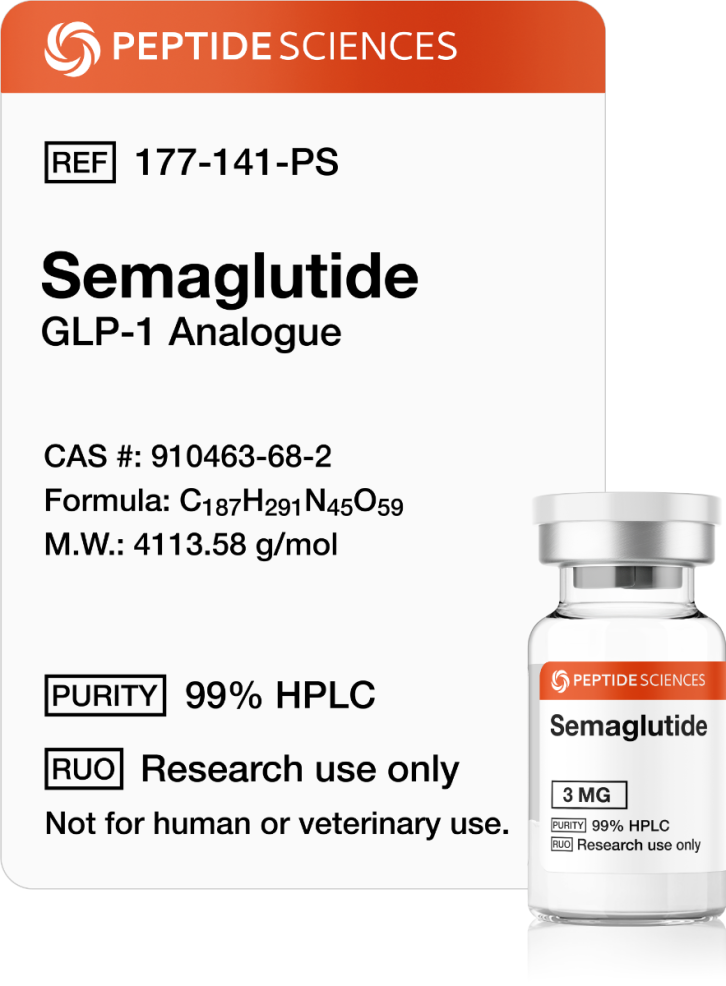
Much of the interest in cagrilintide comes from its investigation in combination with the GLP-1 receptor agonist semaglutide, a co-formulation known as CagriSema. Phase 1b and phase 2 trials published in The Lancet examined the combination against each component alone, and a large phase 3 programme (REDEFINE) has since reported results. The scientific rationale is that amylin and GLP-1 pathways act through different receptors and partly different brain regions, so combining them lets researchers study additive or synergistic effects on metabolic endpoints.
Laboratories building comparative models often source both compounds from the same supplier to keep purity standards consistent, for example Cagrilintide 10mg paired with Semaglutide 3mg or Semaglutide 10mg. If your work also spans dual and triple incretin agonists, our article Semaglutide vs Tirzepatide vs Retatrutide compared explains how those receptor profiles differ, and Tirzepatide 10mg is available for GIP/GLP-1 comparison arms.
Cagrilintide 10mg: Product Specifications
Our Cagrilintide 10mg research peptide is supplied as a lyophilised powder in a sealed vial. When evaluating any batch, researchers should look for:
- HPLC purity – the main peak area as a percentage of total peak area.
- Mass spectrometry – an observed mass matching the expected molecular weight of the acylated peptide.
- Lot traceability – a certificate of analysis tied to the specific batch number on the vial.
Handling and Storage of Cagrilintide in the Lab
Lyophilised cagrilintide is most stable when kept cold, dry and protected from light. General laboratory practice for acylated peptides includes:
- Storing unopened vials at −20 °C for long-term storage, or 2–8 °C for short periods.
- Allowing the vial to reach room temperature before opening to prevent condensation.
- Reconstituting with an appropriate sterile solvent for your assay, adding it gently down the vial wall rather than shaking.
- Aliquoting reconstituted solution to avoid repeated freeze–thaw cycles.
Cagrilintide FAQ
Is cagrilintide a GLP-1 agonist?
No. Cagrilintide is an amylin analogue that acts on amylin and calcitonin receptors. It is frequently studied alongside GLP-1 agonists such as semaglutide precisely because it works through a different receptor system.
What does CagriSema mean?
CagriSema is the name used in clinical research for the co-formulated combination of cagrilintide and semaglutide. Researchers investigating the individual components typically source each peptide separately.
Why is cagrilintide long-acting?
A fatty acid side chain allows the peptide to bind reversibly to albumin, which protects it from rapid clearance. This is the same general half-life extension strategy used for semaglutide.
How should cagrilintide research peptide be stored?
Store lyophilised vials frozen and away from light, and refrigerate reconstituted solution for short-term use only, following your laboratory's SOPs.
Order Cagrilintide for Your Research
Whether you are characterising amylin receptor pharmacology or designing comparison arms against incretin peptides, starting with a well-documented, high-purity compound makes your data easier to interpret. Browse our Cagrilintide 10mg listing for current availability, or explore the full research peptide catalogue.
Shop Cagrilintide 10mgAll products are sold strictly for laboratory research use only. They are not intended for human or animal consumption, or for diagnostic or therapeutic use. Nothing in this article is medical advice.