If you are planning reproductive-endocrinology work, the kisspeptin-10 vs gonadorelin question comes up fast: both are decapeptides that drive luteinizing hormone (LH) and follicle-stimulating hormone (FSH) release, but they act at different levels of the hypothalamic-pituitary-gonadal (HPG) axis. This guide compares their mechanisms, the published research behind each, and the practical points that matter when choosing one for a laboratory study design.

What Are Kisspeptin-10 and Gonadorelin?
Kisspeptin-10 is the shortest biologically active fragment of kisspeptin, the family of peptides encoded by the KISS1 gene. It corresponds to the C-terminal ten amino acids (YNWNSFGLRF-NH2) shared by all kisspeptin isoforms, including kisspeptin-54 (originally called metastin because of early work on cancer metastasis suppression). It binds the kisspeptin receptor, KISS1R (also known as GPR54).
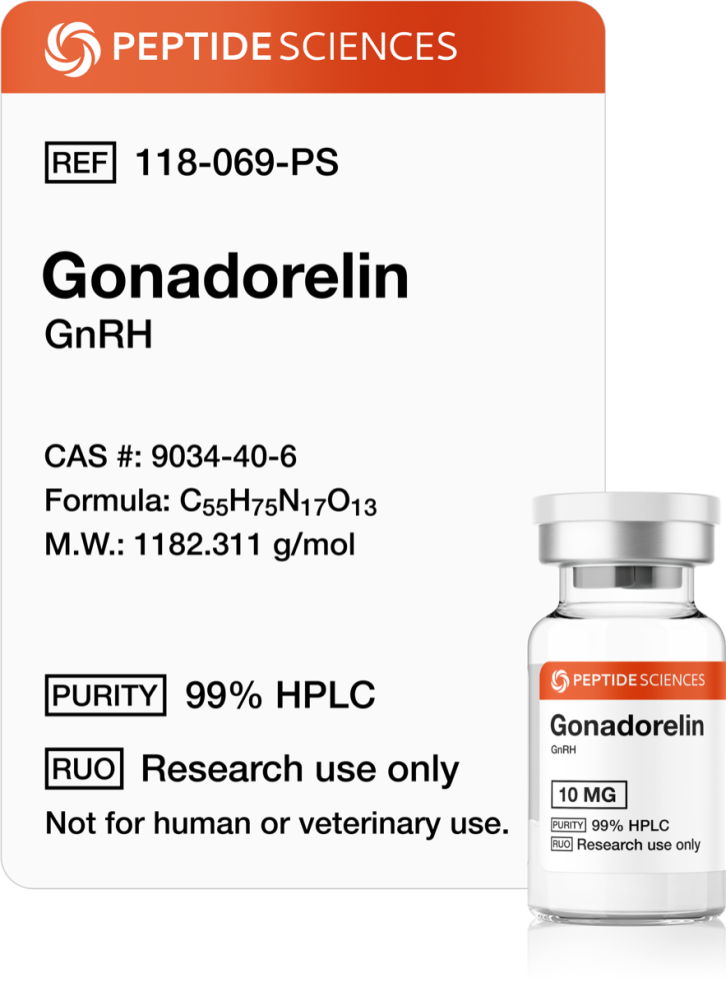
Gonadorelin is the synthetic form of native gonadotropin-releasing hormone (GnRH, also called LHRH), with the sequence pGlu-His-Trp-Ser-Tyr-Gly-Leu-Arg-Pro-Gly-NH2. It is identical to the hypothalamic hormone and binds GnRH receptors on pituitary gonadotroph cells.
In short, the two are related links in the same signalling chain: kisspeptin is widely studied as an upstream regulator of GnRH release, and gonadorelin is GnRH.
Kisspeptin-10 vs Gonadorelin: Mechanism of Action
The key difference between kisspeptin-10 and gonadorelin is where each one enters the HPG axis:
- Kisspeptin-10 acts at the hypothalamus. KISS1R is expressed on GnRH neurons. In animal models, kisspeptin signalling stimulates these neurons to release endogenous GnRH, which then travels to the pituitary. Its downstream effect therefore depends on intact, responsive GnRH neurons.
- Gonadorelin acts at the pituitary. It bypasses the hypothalamus entirely and binds GnRH receptors on gonadotrophs directly, triggering LH and FSH secretion.
- Exposure pattern matters for both. Native GnRH is secreted in pulses, and research consistently shows that pulsatile GnRH receptor stimulation maintains gonadotropin output, whereas continuous exposure leads to receptor desensitization. Studies have reported that sustained kisspeptin exposure can also produce tachyphylaxis in some models.
Kisspeptin-10 in Published Research
Kisspeptin moved to the centre of reproductive neuroendocrinology in 2003, when two independent groups reported that loss-of-function mutations in GPR54 were associated with hypogonadotropic hypogonadism, and that mice lacking the receptor showed a similar phenotype. Since then, kisspeptin-10 has been studied for:
- Its role in puberty onset and the regulation of GnRH pulse generation in rodent and primate models.
- How sex steroids feed back onto hypothalamic kisspeptin neurons, including differences between the arcuate nucleus and anteroventral periventricular populations.
- Acute LH responses in clinical research settings, where investigators have used kisspeptin peptides as probes of hypothalamic function.
- Links between energy balance, metabolic signals and reproductive function.
Gonadorelin in Published Research
Gonadorelin has a much longer research history. The structure of GnRH was characterized in the early 1970s, work recognized with the 1977 Nobel Prize in Physiology or Medicine. Since then, the synthetic decapeptide has been studied for:
- Pituitary responsiveness testing: GnRH stimulation protocols have long been used in research to assess whether gonadotrophs can respond to a direct signal.
- Pulsatile versus continuous receptor stimulation, research that underpins the development of longer-acting GnRH agonist and antagonist analogues.
- GnRH receptor signalling pathways, including Gq/11-coupled calcium mobilization and gonadotropin subunit gene expression in cell models.
- Comparative endocrinology across species, since the GnRH sequence is highly conserved in mammals.
Side-by-Side Comparison for Study Design
- Receptor: Kisspeptin-10 binds KISS1R (GPR54); gonadorelin binds the GnRH receptor (GnRHR).
- Site of action: Kisspeptin-10 acts on hypothalamic GnRH neurons; gonadorelin acts on pituitary gonadotrophs.
- Length: Both are decapeptides with an amidated C-terminus; gonadorelin also carries an N-terminal pyroglutamate.
- Approximate molecular weight: about 1,302 Da for kisspeptin-10 and about 1,182 Da for gonadorelin.
- What a response tells you: An LH response to kisspeptin-10 suggests the hypothalamic GnRH neurons and the pituitary are both responsive; an LH response to gonadorelin tests the pituitary directly.
- Typical research questions: Kisspeptin-10 suits studies of puberty, hypothalamic feedback and neuroendocrine integration; gonadorelin suits studies of pituitary function, GnRH receptor pharmacology and pulsatility.
Purity, Handling and Storage of Reproductive Peptides
Whichever peptide you choose, data quality starts with the material. Short peptides like these are sensitive to small sequence errors, truncations and oxidation (the tryptophan residue present in both is a common oxidation site), so look for:
- A batch-specific certificate of analysis showing HPLC purity and a mass spectrometry result that matches the expected molecular weight.
- Lyophilized supply, stored cold and dry until reconstitution.
- Aliquoting after reconstitution to avoid repeated freeze-thaw cycles.
FAQ: Kisspeptin-10 and Gonadorelin
Is kisspeptin-10 the same as GnRH?
No. Kisspeptin-10 is a KISS1R agonist that acts upstream of GnRH neurons; gonadorelin is synthetic GnRH itself. They share a pathway but have different receptors and sequences.
Why compare kisspeptin-10 vs gonadorelin in the same study?
Because one acts at the hypothalamus and the other at the pituitary, comparing responses to each can help researchers determine which level of the HPG axis is altered in a given model.
Which has a longer duration of action?
Both are short-acting in their native forms. Native GnRH is rapidly degraded, and kisspeptin-10 is generally reported to act more briefly than the longer kisspeptin-54 isoform. Exact kinetics depend on the model and route used in each study.
What purity should I look for?
Most researchers look for high HPLC purity backed by a mass spec identity confirmation on a batch-specific COA, so results can be attributed to the intended sequence.
Source Kisspeptin-10 and Gonadorelin for Your Lab
Kisspeptin-10 and gonadorelin are complementary tools: one probes the hypothalamic gatekeeper of reproduction, the other probes the pituitary directly. Choosing between them, or using both, comes down to which part of the HPG axis your research question targets. Peptide Sciences supplies both as lyophilized research peptides, alongside related neuropeptides in our research peptide shop.
Shop Kisspeptin-10 5mgAll products are sold strictly for laboratory research use only. They are not intended for human or animal consumption, or for diagnostic or therapeutic use. Nothing in this article is medical advice.